
Coleman Low Release Scope
FCI Coleman Low is the low-security federal correctional institution at FCC Coleman. BOP lists it separately from Coleman Medium and the two penitentiaries. Its satellite camp is a component, not a fifth institution with another person-search system. Both the main low-security institution and camp assignments use the national BOP locator.
A completed result proves only the federal keeper’s event. A past release date with no BOP location, or a Released or Not in BOP Custody label, confirms exit from BOP for that episode. It cannot prove that ICE, USMS, a state, or a county did not take custody. It also says nothing by itself about court-ordered federal supervision.
Check Coleman Low Release
Search the BOP Inmate Locator by register number whenever possible. Other federal identifiers may also work. For a name search, use age, race, and sex to narrow results, then compare each field. Do not accept a name-only match.
- Enter the federal register number or full name.
- Match identity and preserve the register number.
- Read Release Date in relation to today.
- Check whether Location still names a BOP assignment.
- Investigate any transfer, community placement, or receiving keeper.
A future date is projected and can change. “Unknown” means the public confinement term is not determined. “In Transit” means movement. A named Coleman or other BOP site means the person remains within the federal assignment structure.
The Sumter County release and records search helps when the original keeper is not known.
Coleman Low Camp Records
The camp is adjacent to and administered as a component of Coleman Low. A person may remember the camp as the physical placement, while the public record uses the institution or complex label. Keep the register number fixed and read location changes as assignments, not new identities.
| Public clue | Release conclusion |
|---|---|
| Coleman Low or camp-related assignment | Still within the institution structure |
| Different Coleman institution | Complex transfer, not discharge |
| In Transit | Federal movement |
| Community Corrections Management | BOP community placement stage |
| Past date with no BOP location | Completed BOP exit |
No separate camp page or camp release feed is needed. BOP’s person record follows the federal identifier across the component and any later assignment.
Coleman Low Contact Route
Name FCI Coleman Low in correspondence even though the major institutions share the complex address reported by BOP. Use the official Coleman directory for current contact routing and the national locator for person status.
846 NE 54th Terrace
Coleman, FL 33521
Federal Bureau of Prisons
Use official BOP directory for current contact
The official Coleman institution search confirms the separate low-security name. Provide the register number with any inquiry so the camp or complex label does not send the question to the wrong institution.
Coleman Low ICE Check
A completed BOP release may be followed by immigration custody when that path applies. ICE’s Online Detainee Locator searches current and some recent ICE custody, but it is not a historic release ledger. Absence can reflect delay, restricted data, age limits, or the fact that the person is held elsewhere.
The official ICE detainee locator offers an A-number route or a name, date-of-birth, and country route. Use it only after BOP shows exit or another record points to immigration custody. Never treat an ICE no-match as proof that the person returned to the community.
The official locator view below illustrates this separate keeper and its current-custody limits.
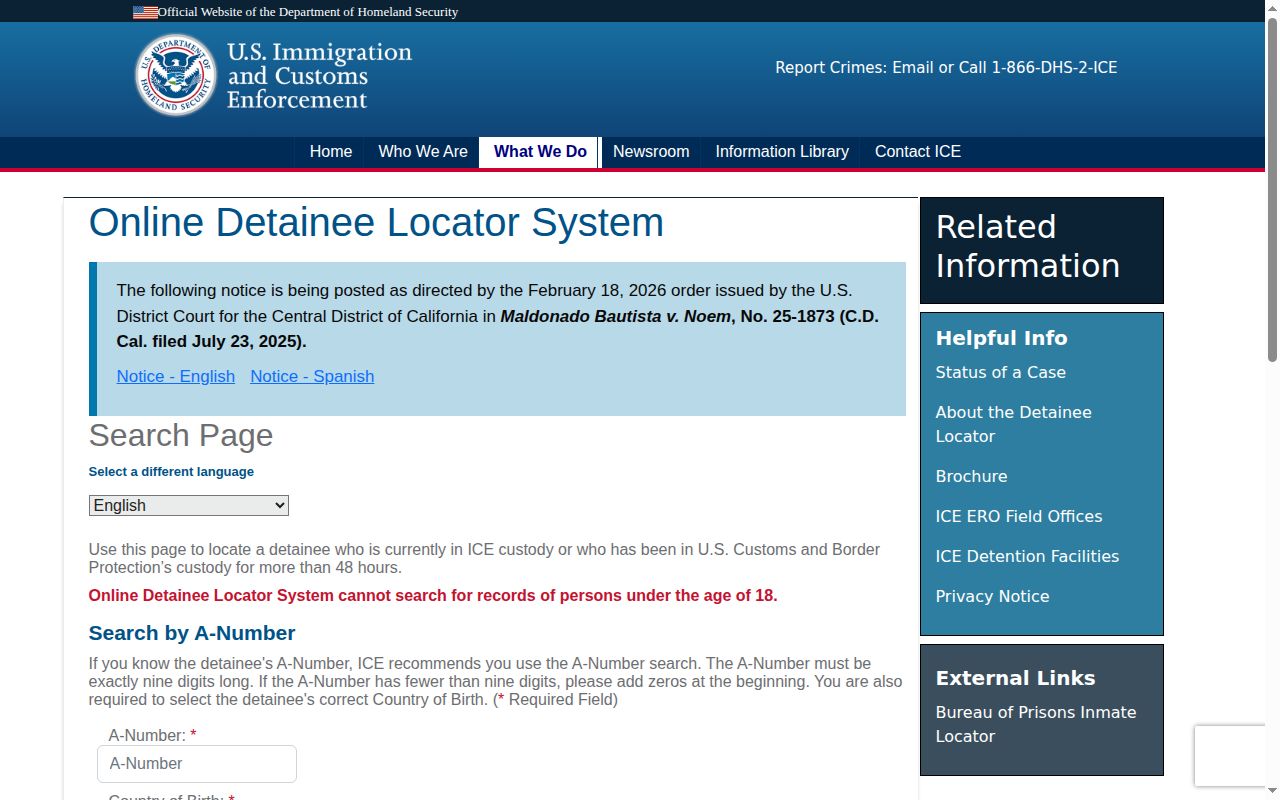
The ICE search is a follow-up channel, not the source for the original Coleman Low BOP release.
Coleman Low Status Terms
The date and location fields cannot be separated. A future date beside Coleman Low describes a projection for a current BOP assignment. A past date without a facility supports completed exit. Community Corrections Management can indicate a halfway-house or related community placement administered within BOP, not final discharge.
The BOP locator record guide explains these fields. First Step Act credit recalculation can change future dates. A federal court order may also affect the term, but the docket records legal action while BOP records operational custody status.
- Camp
- A satellite component of Coleman Low, not another database.
- In Transit
- Movement in the federal custody chain.
- Community placement
- A BOP-managed stage outside a secure prison setting.
- Released
- Exit from BOP, with other custody or supervision still possible.
Coleman Low Federal Boundary
Angle T matters because Sumter County holds all four named Coleman institutions. Local geography does not merge federal, state, and county records. Florida VINE does not receive BOP inmate data. FDC cannot confirm a federal term. SCSO SmartWEB cannot prove departure from Coleman Low.
Use the same register number through each Coleman move. A shift to Coleman Medium or a penitentiary is transfer within BOP. A shift to Community Corrections Management is a federal placement stage. Only the past-date and released/no-location pattern confirms exit from BOP.
If a new keeper appears, open a new custody line in the timeline. This avoids the common mistake of treating release by one agency as release by all agencies.
Request Coleman Low Records
For an underlying departure, release, or transfer record, use the appropriate BOP federal records process. Identify the person by name and register number, specify FCI Coleman Low or its camp component, give the approximate date, and name the existing record sought. Ask for any releasable destination field if the handoff is the issue.
The federal court docket may supply the judgment, order, or sentence modification. It is not a real-time custody ledger. Pair it with BOP’s release date and location. USMS movements require court and holding-agency follow-up because the Marshals Service does not offer a broad public historical release locator.
Privacy and security rules can limit records. A focused request is still useful because it lets the custodian produce nonrestricted portions without inventing a new report.
After Coleman Low Release
Federal supervised release may begin when incarceration ends. It is imposed by the federal court and differs from Florida probation or parole. The judgment and later docket entries identify that term. A BOP released result can therefore coexist with ongoing federal supervision.
Document the register number, past release date, last BOP location, and search date. If another authority takes custody, add its affirmative record. If no receiving result appears at once, allow for update lag and use the contact fallback rather than making a broad claim.
The most accurate statement stays narrow: the BOP record confirms exit from its custody on the listed date. Any later custody or supervision requires separate proof.
Coleman Low Release Evidence
A dated locator copy should preserve the name, register number, release date, location, and exact status wording. These fields show whether the result concerns Coleman Low, its camp component, another BOP assignment, or completed exit. Saving only the date can hide that distinction.
When a court order, BOP action, and later agency intake occur on different dates, list all three. The court supplies authority. BOP records its custody action. A receiving keeper records the next episode. None cancels the others.
If the public result remains unclear, request an existing federal departure, transfer, or release record using the register number and approximate date. Ask for any releasable destination. This keeps a camp move from being mislabeled as final release and ties the Coleman Low event to the right record.
Coleman Low Event Timeline
List the last confirmed Coleman Low or camp assignment first. Add transit, community placement, or another BOP institution exactly as shown. Record final BOP exit only when the past date and released or no-location pattern appear. A receiving agency belongs on a new line after its own match is confirmed.
Preserve the register number through every BOP stage. Use a federal case number for the court order. Those two identifiers prevent the camp component, a complex transfer, and a judicial event from being blended into one vague release claim. They also help the federal records office locate the specific movement or release record when the public display lacks a destination.