
USP Coleman II Release Test
USP Coleman II is the second separately named federal penitentiary at FCC Coleman. Its records use the national BOP system. The reliable public test is not simply whether Coleman II disappears from a location field. Match the person, read the listed release date in relation to today, and check whether a BOP location remains.
A past date combined with Released, Not in BOP Custody, or no BOP facility location confirms exit from BOP for the listed federal episode. It does not rule out U.S. Marshals, immigration, state, or local custody. Nor does it end a court-imposed term of federal supervised release. State the conclusion at the keeper level: BOP custody ended.
Match Coleman II Identity
Use the BOP Inmate Locator and search by register number when possible. That federal identifier is more exact than a name. If only a name is known, add age, race, and sex where available, then compare every field before accepting the match. Similar names and changed ages can produce uncertainty.
The result can show name, register number, age, race, sex, release date, and location. Save the register number. It links later searches even if the person moves from Coleman II to another BOP institution. A future release date is a projection and may change. “Unknown” means the public term date is not determined.
- Find and preserve the federal register number.
- Compare all identity fields.
- Classify the date as past, future, or unknown.
- Read the location and status at the same time.
- Follow any named receiving system.
Coleman II Status Language
BOP status words describe different operational stages. “In Transit” means movement within the federal custody chain. A named prison means a present BOP assignment. Community Corrections Management often points to an administrative structure for a residential reentry center or community placement. None of those labels alone proves sentence discharge.
| Result pattern | Safe reading |
|---|---|
| Coleman II plus future date | Current federal assignment with a projected date |
| In Transit | Movement, destination not yet settled publicly |
| Another BOP facility | Federal transfer |
| Community Corrections Management | BOP community-placement stage |
| Past date and no BOP location | Completed exit from BOP |
The BOP record-field explanation is the official source for these distinctions. It is more useful than guessing from a blank county search.
USP Coleman II Contact
Address institution correspondence to the correct named penitentiary. FCC Coleman includes two penitentiaries and two federal correctional institutions. Sharing a campus does not make their assignments interchangeable.
846 NE 54th Terrace
Coleman, FL 33521
Federal Bureau of Prisons
Check the official directory for current routing
The Coleman institutional directory is the source for current office routing. The locator, rather than a facility phone exchange, remains the standard public status check. Include the register number and approximate dates in any record inquiry.
The BOP field guide image below shows how federal release records are interpreted.
Review BOP’s released-status and date guidance.
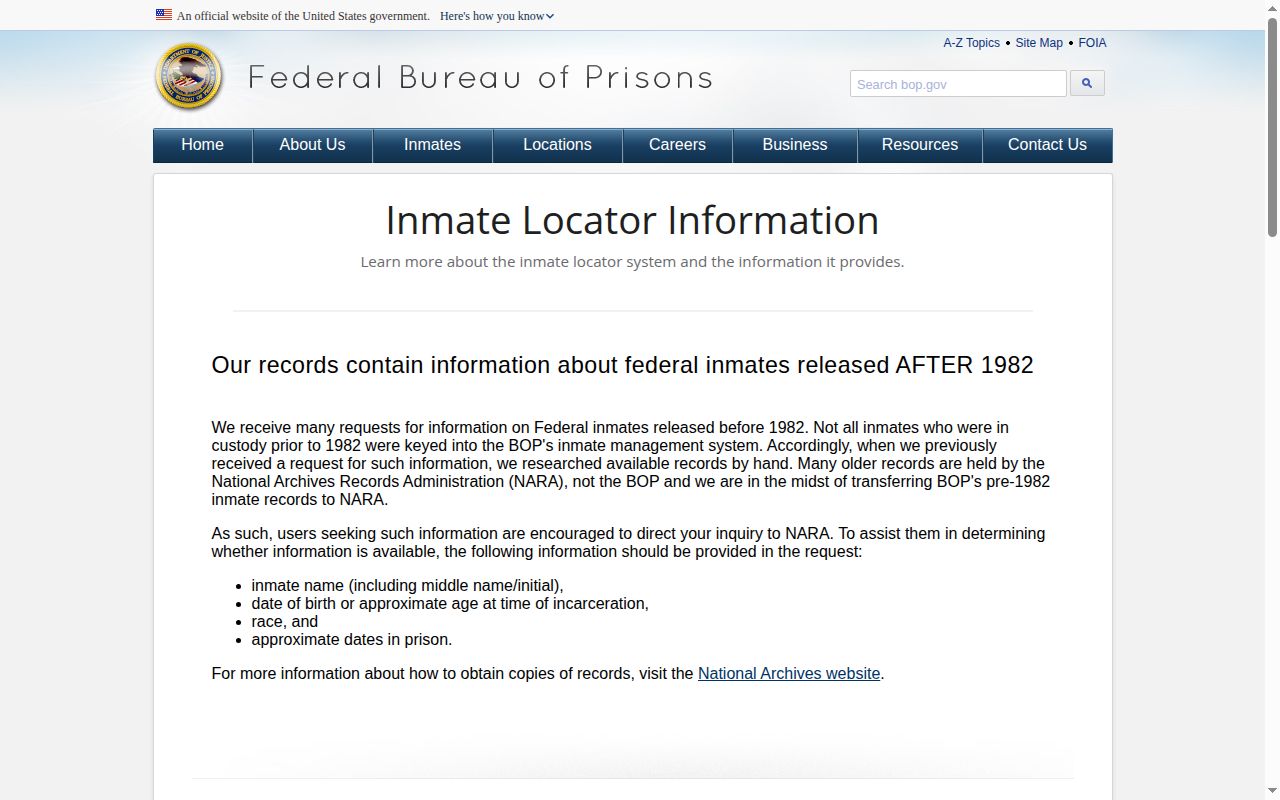
The guidance applies to the national record; the matching register number ties it to a Coleman II prisoner.
Coleman II Custody Handoffs
A federal release can be followed by another keeper. USMS handles many federal defendants before designation and during some movements, but it does not publish a historic released-person locator like BOP. ICE has a current and recent detainee locator with limits. A state or county agency uses its own system. Search the agency named in a transfer or destination record.
A BOP “Released” result should not be stretched beyond its scope. If ICE takes custody, BOP release and immigration detention are both true. If a state warrant causes pickup, exit from federal prison and entry into state custody can occur in sequence. A blank result from the next database may reflect update lag or access limits.
Keep a timeline: Coleman II assignment, movement status, BOP release date, receiving keeper, and later supervision. This method resolves apparent conflicts without treating one agency’s release as the end of every case.
Coleman II Federal Records
A locator result is a concise public status record. For the underlying release, departure, or transfer material, use the appropriate BOP federal records process. Ask for an existing record tied to a full name, register number, USP Coleman II, and an approximate date. If destination is the issue, request any releasable receiving-agency or transfer field.
The federal court docket supplies the legal side. A judgment, sentence modification, or release order can explain authority, while BOP records show agency execution. The two dates may differ because the agency must process the order. Court action by itself is not a prison-gate timestamp.
Federal privacy and institutional-security rules can restrict details. A focused request allows the custodian to identify responsive public portions. Do not ask the agency to create a new narrative about a person’s current whereabouts.
Coleman II Release Boundary
Angle T is unusually local to Sumter County. Four named BOP institutions sit within FCC Coleman, alongside a county jail and an FDC prison elsewhere in the county. The federal locator is therefore part of a county-focused release search even though the county government does not operate it.
Florida VINE does not receive BOP inmate data. The Sheriff’s released-only search covers Sumter County Detention Center, not Coleman II. FDC’s released-inmate search covers state prison commitments, not federal terms. The Sumter County custody-system comparison helps select the right keeper without mixing records.
Within BOP, Coleman II also remains distinct from Coleman I and the two FCIs. A campus move is a federal transfer. The same register number, not the campus address, determines the person-specific trail.
After USP Coleman II
Federal supervised release comes from the sentencing court. It can begin after BOP incarceration ends and is not the same as Florida probation or parole. Check the federal judgment and later docket entries for its term. A completed BOP result confirms prison release but not completion of that court-imposed supervision.
When the person appears in another custody system, use that keeper’s affirmative record. For ICE, search ODLS and use ERO contact guidance if the match is absent. For state custody, use the state corrections locator. For county custody, use the receiving jail. Each system has a different update cycle.
A sound final note names the source and scope: “BOP lists a past release date and no current BOP facility.” That wording is accurate, verifiable, and does not claim facts the locator cannot prove.
Coleman II Release Evidence
Preserve a dated copy of the matching locator result. The useful evidence set contains the full name, register number, release date, location, and status wording. A later move or corrected projection can change the live display. The saved fields show what BOP reported at that point without turning an old result into a claim about the present.
If a court order appears before the BOP update, note both events. The order supplies legal authority, while the locator records the public federal custody action after processing. If a receiving agency later posts an intake, add that as a third event. This sequence is more accurate than searching only the Coleman II institution name.
A records request should use the same identifiers. Specify the federal episode and approximate date, and ask for an existing release or transfer record.
Coleman II Record Timeline
Start the timeline with the last confirmed Coleman II assignment. Add any transit label, the BOP past release date, and then an affirmative receiving-agency entry when one exists. Do not fill a gap with an assumption. Federal movements can post at different times, and each agency controls only its own record.
Place the register number next to every BOP event. Place the federal case number next to a court order. These identifiers show why a legal order, a prison release, and a later intake can all carry different dates without conflict. They also make a focused record request easier for the agency to locate and review.