
USP Coleman I Release Status
United States Penitentiary Coleman I is a separately named high-security federal penitentiary within Federal Correctional Complex Coleman. Its public custody records belong to the Federal Bureau of Prisons. The Sumter County Sheriff’s portal covers county jail bookings, and FDC covers Florida state commitments. Neither can confirm departure from this federal institution.
A past BOP release date with no facility location, or a result expressly marked Released or Not in BOP Custody, confirms exit from BOP for that record. It does not show that all legal control ended. U.S. Marshals custody, state or local custody, ICE detention, or federal supervised release may follow. The release result must be described as an exit from BOP, not a universal freedom certificate.
Search USP Coleman I Records
The BOP Inmate Locator covers federal inmates from 1982 forward. Search by the BOP register number or another accepted federal identifier when available. A name search can be narrowed with age, race, and sex. Compare the result carefully because similar names do not establish identity.
- Enter the register number for the most exact search.
- Otherwise use the full name and available identity filters.
- Match the register number, age, race, and sex.
- Read Release Date together with Location.
- Trace any named location or other-authority clue before calling it community release.
A locator result commonly shows name, register number, age, race, sex, release date, and location. A future date is projected and can change. “Unknown” means the confinement term has not been determined in the public field. A past date without a BOP site is the key completed-release pattern.
The Sumter County release-record hub explains when a county, state, or federal keeper controls the record.
USP Coleman I Transfers
A move from USP Coleman I to USP Coleman II, either Coleman FCI, the camp component, another BOP prison, or U.S. Marshals custody is a transfer. The person’s federal register number should remain the core identifier. A short location gap during movement does not prove release, and the locator may use “In Transit” while BOP processes the move.
| BOP display | Meaning for release checking |
|---|---|
| Named BOP institution | Still assigned within BOP |
| In Transit | Moving between custody points |
| Community Corrections Management | BOP community-placement structure, not automatic discharge |
| Future release date | Projected date that may change |
| Past date, no BOP location | Exit from BOP for the listed episode |
Community Corrections Management can relate to a residential reentry center or other BOP community placement. It should not be read as physical residence at an administrative office. It can be a pre-release stage inside the federal correctional structure.
USP Coleman I Contact
Use the official Coleman institutional search to identify current institution contact details. All four named Coleman institutions share the complex address in the research source, but they remain distinct BOP institutions. Correspondence should name USP Coleman I and include the register number when it concerns a particular record.
846 NE 54th Terrace
Coleman, FL 33521
Federal Bureau of Prisons
Use the official institution directory for current contact routing
The official Coleman institution list confirms the separate names within the complex. Facility staff can address institution routing, while the national locator remains the public status source.
The official list view below helps separate USP Coleman I from the adjacent federal institutions.
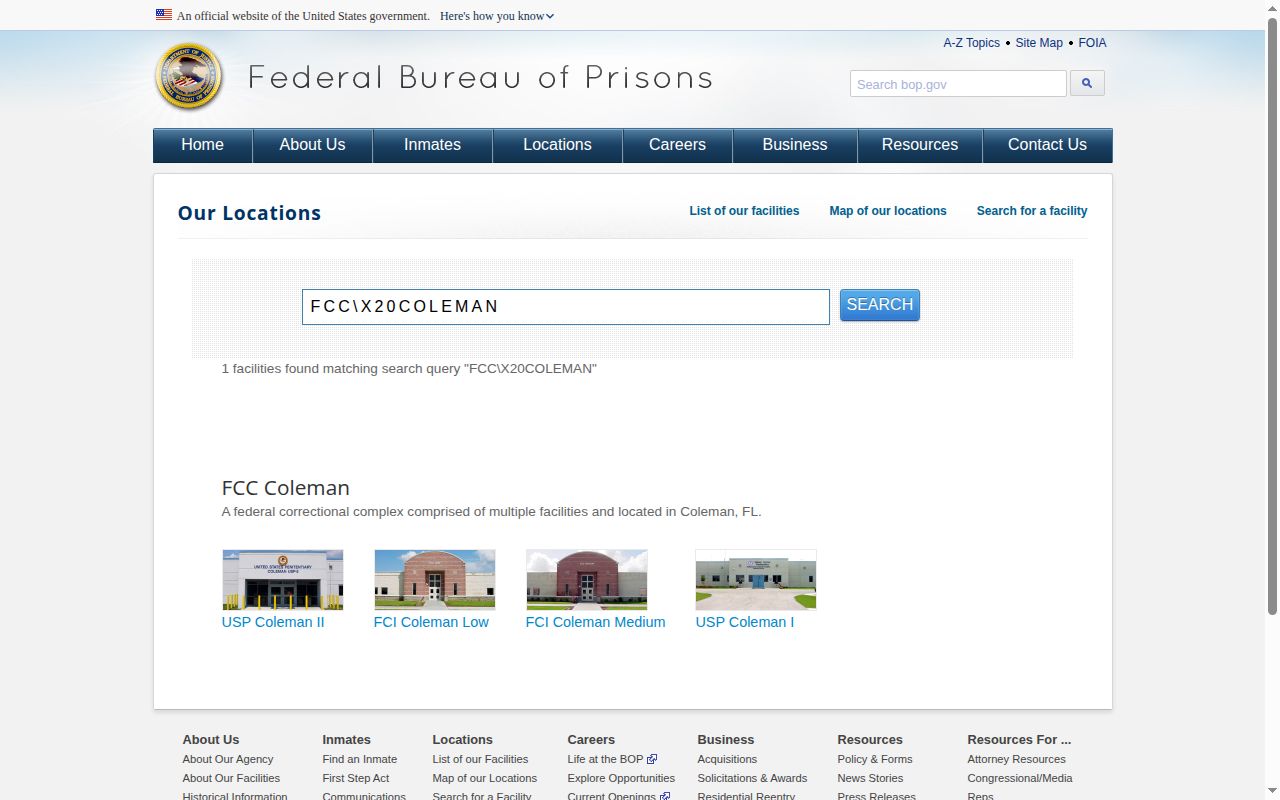
The list identifies the correct institution; it does not replace a person-specific BOP locator result.
Read Coleman I Release Fields
BOP’s field guidance is crucial when a result has no plain narrative. Read the date as past, future, or unknown. Then read the location. A past date and blank BOP location support completed exit. A future date paired with USP Coleman I supports continuing assignment with a projection. Another institution or transit label points to movement instead of discharge.
First Step Act credit recalculation can alter a future date. Court action can also affect the term, but a court order and a BOP release entry answer different questions. The federal docket shows what the judge ordered. BOP shows the public custody status after the agency processes that authority.
- Register number
- The federal identifier that links the person to the BOP record.
- Release date
- A past completed date or a future projection, depending on context.
- In Transit
- A movement status within the federal custody chain.
- Released
- Exit from BOP, subject to other custody and supervision.
Coleman I Federal Boundary
Sumter County contains four named BOP institutions at FCC Coleman. That makes the national locator unusually important to local release questions. Yet the shared campus does not create a county database. USP Coleman I has the same federal search system as its siblings, and Florida VINE does not receive BOP inmate data.
The BOP locator field guide explains Released, release date, location, transit, and other-custody cautions. Its wording supports a precise conclusion: the person is no longer in BOP custody as of the listed past date. It does not prove that ICE, USMS, a state, or a local agency did not take custody.
This Angle T distinction is central in Sumter. One county contains county, state, and federal institutions, but each keeper closes only its own custody episode.
After Coleman I Release
Federal supervised release is imposed by the court and follows incarceration in many cases. It is not displayed as a Florida probation record merely because Coleman sits in Florida. Review the federal judgment and docket for the term and conditions, and use the appropriate federal supervision contact when needed. BOP release and federal supervision are separate stages.
If an immigration hold is involved, use ICE’s current detainee locator and contact fallback. ICE absence alone is not proof of community return because public data can be delayed or restricted. For a U.S. Marshals prisoner, the federal court and holding agency are essential because USMS does not operate a public historic released-person locator comparable to BOP.
Record the completed BOP result, the register number, and the date searched. Those details make later changes easier to reconcile without confusing a new custody episode with the original USP Coleman I release.
Request Coleman I Records
The public locator is the first status check, not the entire federal file. When the reason, destination, or legal authority matters, request the existing BOP record through the appropriate federal records channel and consult the federal court docket. State the full name, register number, institution, approximate dates, and the exact release or transfer record sought.
A focused request is more useful than asking staff where someone is now. Ask for an identified departure, release, or transfer record and any destination field that is releasable. Federal privacy and security rules may limit production. The court docket may provide the release order, sentence modification, or judgment, but it may precede BOP’s operational update.
When sources disagree, keep the register number fixed, verify the result again, and contact the office tied to the most recent affirmative custody record. Silence in a different system is not evidence.
Coleman I Release Evidence
Save the matching name, register number, release date, location, and search date. Those fields form a compact evidence set for the federal episode. If another keeper appears later, record that agency as a new event rather than changing the meaning of the BOP release.
When no register number is known, the federal docket may supply it. Match that identifier back to BOP before relying on the date. This check keeps the United States Penitentiary Coleman I event tied to the correct person.
Coleman I Record Timeline
Build the timeline from affirmative records. Begin with the last Coleman I assignment, add any In Transit display, then record the past release date. If another agency receives the person, add its intake only after a matching result appears. This method leaves room for update lag without guessing. It also makes clear whether a later result is a continuation of the same federal movement or a separate custody episode.
The register number should appear beside each BOP event. A court case number belongs beside judicial action. Keeping those identifiers separate prevents a court order from being mistaken for the operational exit and helps a records custodian locate the exact federal document.